
Understanding Muskogee County Releases
A release ends one agency's custody event. It does not always mean the person entered the community. Someone may leave Muskogee County Jail after bond, a court order, dismissal, time served, sentence completion, or another authorized release. The same roster change can mark transfer to the Oklahoma Department of Corrections, another county, Muscogee Nation custody, the U.S. Marshals Service, or immigration custody. The next record depends on the destination.
The official sheriff page describes its population as in-custody inmates. Muskogee County released inmates usually disappear from that list, but absence alone is weak proof. The page may be updating, a name may differ, or another authority may now hold the person. A sound finding matches the jail's completed release record with a status relay such as Oklahoma VINE and the court or board record that authorized the change.
- Release
- The end of a specific custodian's control, either to the community or another agency.
- Discharge
- A completed corrections or supervision obligation shown by the responsible agency.
- Parole
- Conditional community release before the sentence expires.
- Time served
- A sentence resolved with credit for time already spent in custody.
Muskogee County Release Types
The release code and destination matter more than the fact that a name vanished. Bond normally leaves the case pending. Dismissal resolves a charge but does not rule out another case or hold. Parole places an eligible state prisoner under conditions. Transfer closes the local jail episode while custody continues elsewhere. MCSO should interpret any local code that is not plain on the record.
| Type | Meaning | Next source |
|---|---|---|
| Bond or recognizance | Local custody ends under court terms | MCSO record and OSCN docket |
| Dismissal or order | A case event authorizes release | Court order plus jail timestamp |
| Time served | The custodial term is credited or complete | Judgment and actual release record |
| Parole or probation | Community supervision may follow | ODOC, PPB, and supervising office |
| Transfer | Another authority receives the person | Receiving state, tribal, federal, or county system |
A court order and a physical exit can occur at different times. Other holds may delay or redirect the handoff. Pair the legal event with the custodian's timestamp and destination instead of relying on one source.
Muskogee County Release Record Fields
MCSO maintains the local booking and release record. Its public current roster shows identity details, booking date, inmate ID, charges, and a photograph when available. The official data structure also contains booking and release fields, but current rows do not create a public archive. A targeted request is the reliable way to seek the completed event.
| Field | What it can establish |
|---|---|
| Booking or inmate number | Links the request to the correct custody event |
| Booked-in date and time | Marks the start of the jail event |
| Release date and time | Records when MCSO completed the exit or handoff |
| Release code or reason | Identifies bond, order, completion, transfer, or another result |
| Bond and charges | Connects custody to its legal basis |
| Destination or receiving agency | Shows where to continue when custody did not end |
| Booking photograph | Identifies the image tied to that booking |
Not every public copy carries each field. Juvenile, sealed, expunged, medical, security, victim, and other protected material may be withheld. A release record also does not mean exoneration, erased history, or completion of all supervision.
Request Muskogee County Release Records
The MCSO Records Division is the county route for historic booking and release proof. It posts no fixed fee or promised turnaround. Ask for electronic delivery and an estimate before chargeable work. A narrow request gives staff enough detail to find an existing record without asking the agency to create a new report.
- Give the full name, known variants, narrow date range, and a booking or inmate number when available.
- Ask for the booking sheet, actual release time, release reason or code, bond data, releasing authority, and public transfer destination.
- Request a booking photograph only for the identified booking and prefer an electronic copy.
- Ask for a fee estimate and the legal basis for each withheld or redacted field.
220 State Street
Muskogee, OK 74401
918-687-0202
Monday through Friday, 8:30 a.m. to 4:30 p.m.
The official MCSO records screen identifies the correct request channel.
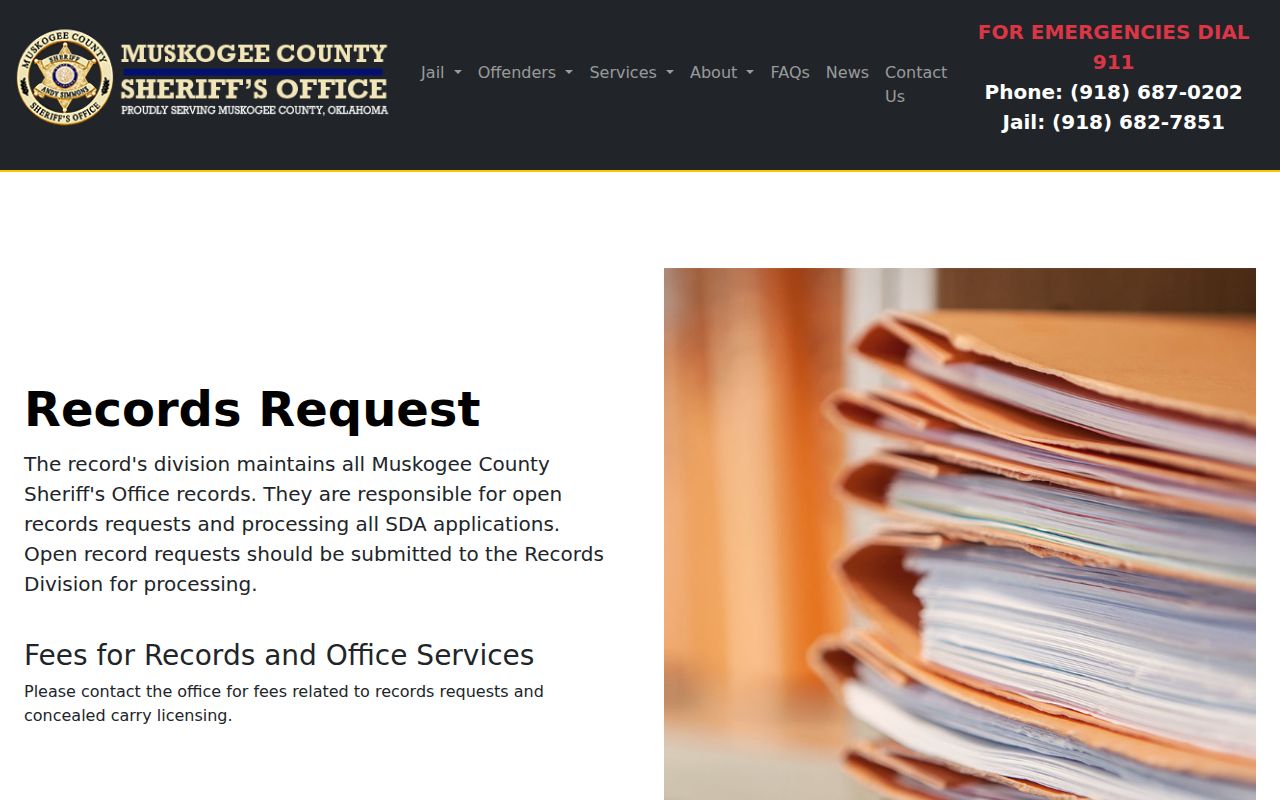
Use it for the completed record, while the live roster remains only a current-custody check.
Muskogee Release Records Law
The Oklahoma Open Records Act, 51 O.S. §§24A.1 and following, supplies the access framework. Section 24A.8 addresses law-enforcement records, while §24A.5 concerns access and permitted charges. The Act does not require MCSO to program a report, answer a custom question, or disclose exempt material. Request existing records for a defined person or period.
Expungement under 22 O.S. §§18 and 19 may alter public access after a court grants relief. Eligibility turns on the case category and governing law. A sealed search result can disappear from public view, but that is not a basis to infer what happened. The clerk or issuing agency controls its own record.
Muskogee Release Orders and Proof
The Muskogee County District Court docket explains the legal authority behind many county releases. Useful entries include a bond order, bond filing, dismissal, plea or verdict, judgment and sentence, jail credit, suspended or deferred term, commitment to ODOC, revocation, sentence change, and later discharge. Preserve the case number because it is a stronger key than a name. Read the charge result and the dated event history together.
A docket is not the jail door log. A judge can authorize release while another hold keeps the person in custody, and processing can occur after an order is entered. For bond, match the bond order or filing with the MCSO release time. For dismissal, check all known cases and holds. For time served, compare the judgment, credited time, and actual custodian record. The Muskogee County Court Clerk provides official copies at 200 State Street, second floor, and can explain access to a specific court document.
OSCN's online display is convenient but not certified. When the timing or exact language matters in a legal process, request the identified order or judgment from the clerk and the physical release record from MCSO. Each source proves a different step.
Muskogee Release Logs by Date
A time-bounded request is the proper substitute for the absent recent-release feed. Define the interval with a start timestamp, end timestamp, and time zone. Ask for any existing Muskogee County Jail release log or equivalent record that covers that window. Identify the fields sought, such as booking number, completed release time, release code, and public transfer destination. A focused request is easier to process than a demand for all data.
The Oklahoma Open Records Act does not force an agency to write new database code. If MCSO says no interval log exists, ask which existing booking and release records can be produced for those dates. Request an electronic file and a cost estimate first. The county posts no set fee or response promise, so another Oklahoma agency's charge or timeline must not be applied to MCSO.
For one named person, a narrow individual request will often provide clearer proof. Include aliases and a booking number when known, but avoid asking the records unit to draw a legal conclusion. Seek the recorded facts and let the code, destination, court order, and receiving agency show the path.
Match Muskogee Release Evidence
Different release types call for different evidence combinations. A bond event is best shown by the court's bond action and the jail's completed exit. An own-recognizance or other court order also needs the jail event because a second hold can delay departure. Dismissal resolves the identified charge, but another case may still control custody. None of those outcomes automatically erases the booking record.
For parole, the PPB docket or result shows the decision stage, ODOC shows implementation and supervision, and VINE may relay a custody event. Terms such as parole to detainer, parole to consecutive sentence, or a condition tied to a program do not describe an immediate street release. Probation and suspended or deferred sentences arise from the judgment, so the court record is primary. A later discharge must be supported by its own record.
Transfers require the clearest follow-through. Ask MCSO to name the receiving authority if that information is public, then move to the receiving county, ODOC, tribal custodian, USMS, BOP, or ICE source. The local episode can be complete while the person's custody continues without a break.
Find Muskogee County Released Inmates
Start with the last known custodian. The MCSO in-custody roster can show whether someone is still listed and can preserve a booking number or case reference. It cannot prove release through a blank result. The sheriff warns that an absent person may have been released or transferred and that updates can affect the display.
- Search the roster by full name and variants. Save the booking and case details if shown.
- Check Oklahoma VINE. Read the exact reporting agency, facility, event, status, and date.
- Use ODOC for an Oklahoma sentence or a person held at either Taft prison. Compare status, location, supervision, and sentence data.
- Search the Muskogee OSCN docket by case number. Read orders, disposition, judgment, jail credit, and later changes.
- Follow tribal, federal, or immigration sources when the holding agency or destination points outside the county system.
- Request the actual MCSO or ODOC release record when online results remain unclear.
The official MCSO roster warning makes that limit clear.
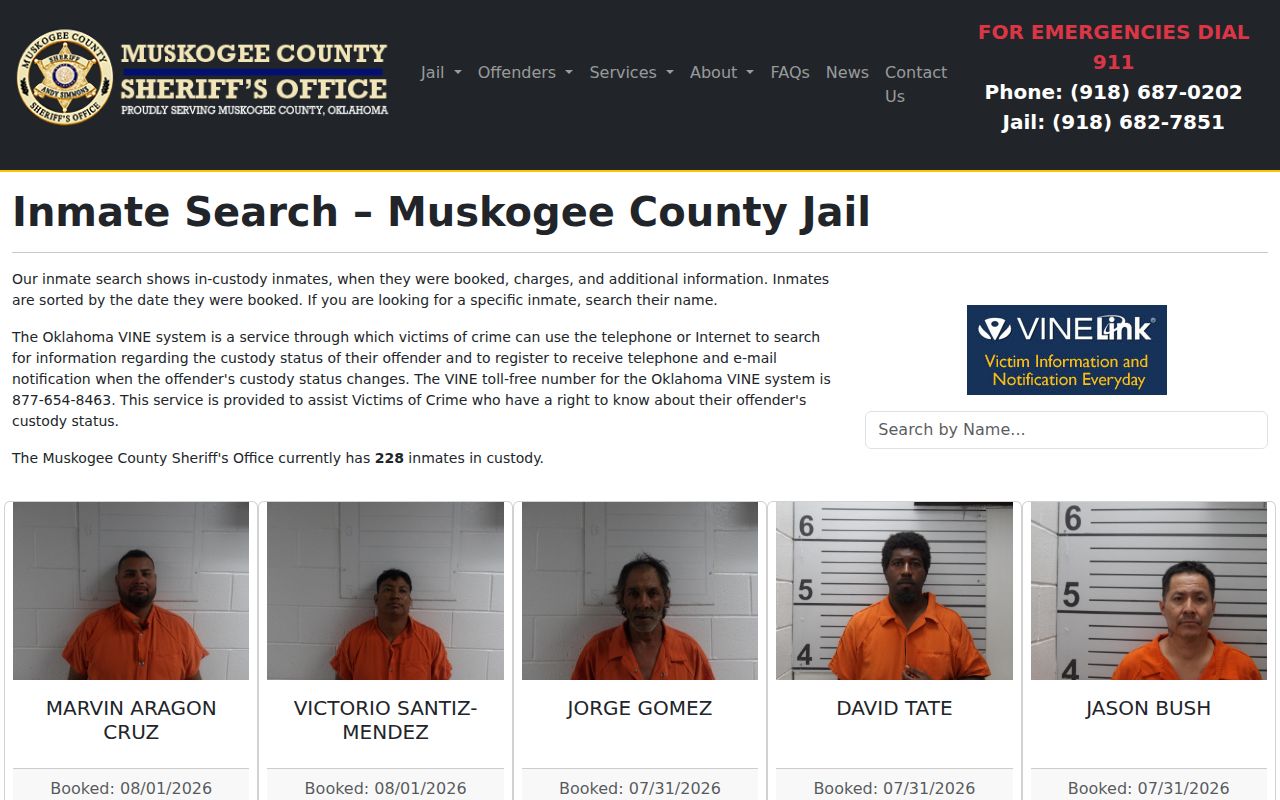
Use it as a cue to continue across sources, not as an answer by itself.
ODOC Muskogee Release Search
The ODOC offender-information hub leads to the official search. Use an ODOC number when known because names collide and change. Otherwise try exact and variant names, open the likely record, and compare the available identity, offense, county, sentence, status, location, and supervision information.
| Search item | How to use it |
|---|---|
| ODOC number | Separates people with similar names |
| Name and aliases | Use exact and reasonable variants |
| Status and location | Read the official label without broad translation |
| Offense, county, sentence | Match the right person and case |
| Supervision information | Separate institutional release from full discharge |
The public lookup should not be promised to display a projected date. PPB dockets can publish PRD and PE DATE for docketed cases, but those planning fields are not guaranteed exit appointments. A short local booking that never became an ODOC sentence may not appear at all.
The official ODOC search controls show the source lookup.
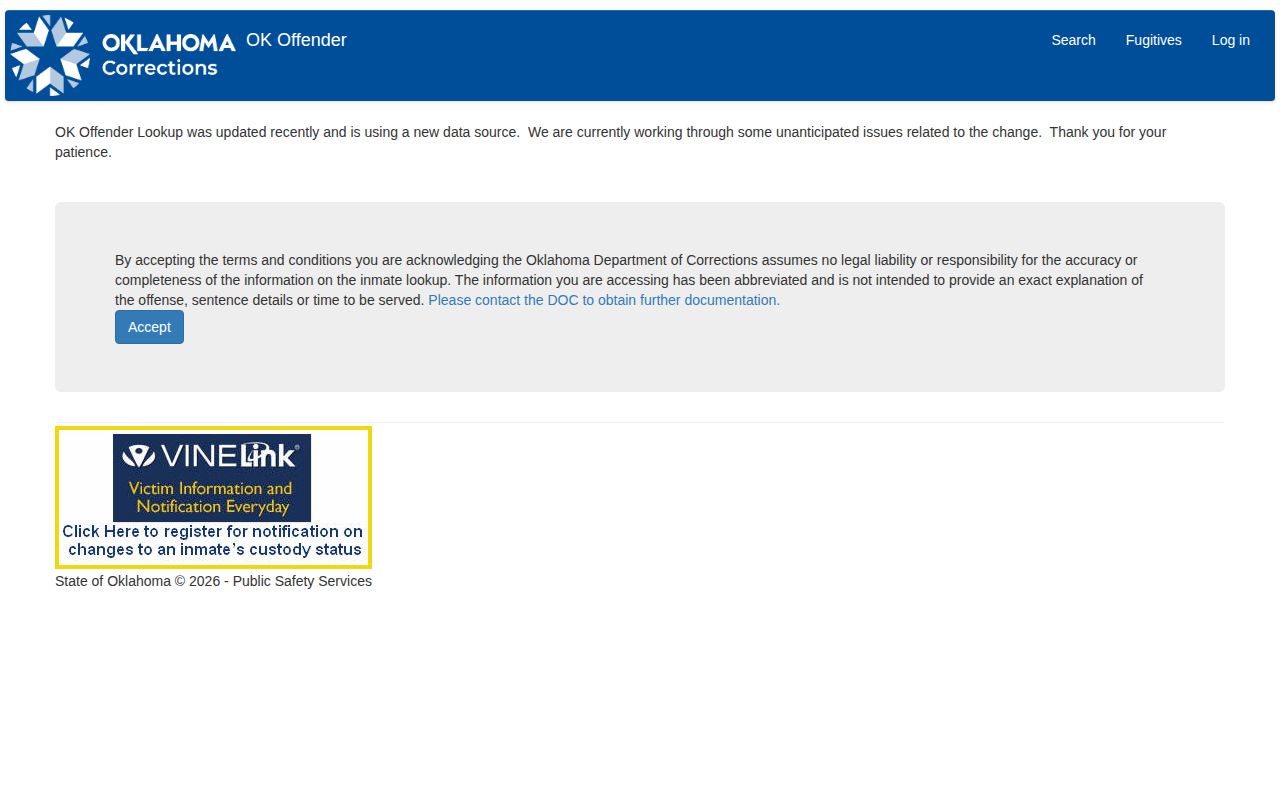
Record the exact status instead of turning a facility absence into an unsupported discharge claim.
County Versus State Release Records
A person released from Muskogee County Jail and a person discharged from an Oklahoma prison belong to different record systems. MCSO records a local booking, its release code, and the physical exit or transfer. ODOC maintains a state offender lifecycle that can include reception, facility movements, sentence information, supervision, and discharge. The county roster cannot confirm a direct release from Jess Dunn or Dr. Eddie Warrior.
Movement within ODOC is also not final discharge. A person may shift to another institution, community corrections, contracted placement, parole, or probation. Read status and location together. When an online state result is unclear or historic proof is needed, request the final discharge or status-change record through ODOC. Identify the DOC number and ask for the actual date, authority, type, and public destination information.
Older or closed ODOC files may require the agency's Closed Records route. A record correction belongs with ODOC through its documented review process, while an error in a county booking belongs with MCSO. Changing one government record does not automatically update every other system.
Muskogee Projected Release Limits
Parole eligibility, projected release, and actual release are three separate dates. Eligibility marks the first point at which review may occur under the governing law. A projected date is an administrative estimate that can reflect sentence structure, jail credit, earned credit, misconduct, programs, and known holds. The actual date records the completed custody event.
Oklahoma PPB docket files may show PRD and PE DATE columns for a case placed on a docket. The docket is a meeting snapshot. It is not a release order. A favorable board action can still require another decision, a certificate, release planning, treatment, a step-down, or resolution of a detainer. Compare the result with ODOC status after the meeting.
For county sentences, no Muskogee-specific good-time schedule, routine weekend adjustment, or standard doors-out rule was verified. ODOC's earned-credit law should not be copied into a county-jail calculation. Ask MCSO for the particular sentence computation and later obtain the actual record.
Verify Muskogee Releases With VINE
Oklahoma VINE is the sheriff's own immediate fallback when a person cannot be found on the MCSO roster. Choose Oklahoma, open Find an Offender, and search by the name or identifier offered on the live form. Compare multiple results with care. The reporting agency, listed facility, exact custody-status wording, event type, and event date are more useful than a name match by itself. A released or out-of-custody event is a lead, while a transferred event points to the next custodian.
A VINE event does not certify why the release occurred. It may not distinguish bond from time served or explain the destination. Participating agencies transmit the data, and updates can lag. When the code, exact time, or receiving authority matters, pair VINE with the MCSO release record. State-prison information can also flow through Oklahoma VINE, but federal custody belongs in federal systems.
Registration is available from the correct offender record when the platform offers notifications. Select the event and delivery channel, enter the phone, text, email, or in-app destination, and complete the live confirmation. A phone flow may ask for a four-digit PIN to acknowledge calls. Keep that PIN and confirmation. PPB parole notices remain separate, so a VINE subscription does not replace the Board's victim-notification program.
Federal Paths After Muskogee Release
Muskogee County Jail can hold a person for federal authorities under a detention-services relationship, but that does not turn the facility into a BOP prison. First identify whether the person is a federal pretrial detainee or a sentenced federal inmate. For a pretrial matter, read the Eastern District of Oklahoma docket, locate the signed detention or release order, and confirm the actual custodian. USMS transport can remove someone from the county roster without creating a BOP release record.
For a sentenced person who entered BOP custody, search by a BOP Register, DCDC, FBI, or INS identifier when known, or use the name and optional details. BOP can display name, register number, age, race, sex, release date, and location. A past date with no facility, or a location marked RELEASED, means the person is no longer in BOP custody. It does not rule out supervision or custody held by another authority.
A future BOP date is projected. UNKNOWN means the term is undetermined, and IN TRANSIT does not mean release. Public locator coverage generally reaches people released after 1982, so older records may require archival research. If no BOP match exists for a Muskogee federal case, check the court and custodian before drawing any conclusion.
Muskogee Release Access Limits
Online systems are convenient, not complete archives. A released person normally drops from the current MCSO roster, and the sheriff does not promise how long any row remains visible. Oklahoma VINE may show a recent reported event but is not a certified record. ODOC covers state corrections rather than every short county stay. PPB covers parole consideration and action, while OSCN covers state court events. Each gap is expected when the wrong system is searched.
Public access can also narrow because of law. Juvenile matters follow separate restrictions. Sealed or expunged cases may no longer appear through the public court search. Medical, victim, security, and personally protected data can be redacted. Those limits do not authorize a claim that no custody event occurred. Ask the record custodian what can be disclosed and request the legal basis for withholding.
When a source fails, preserve the identifiers already found and move one step outward. A booking number helps MCSO, a case number helps the clerk, and an ODOC number helps state corrections and PPB. A receiving-agency name can resolve an apparent contradiction between local release and continued custody. The strongest conclusion is a matched set of the actual custodian record, a status relay, and the controlling court or board document.
Muskogee County Recent Releases
Muskogee County publishes no official rolling 24-hour, 48-hour, or 72-hour release view. The roster is expressly current custody. It offers no released-person archive, retention window, update schedule, or recent-release control. Although the official data structure has a ReleaseDate field, current public rows do not form a historical feed.
For one person, search VINE, call the jail, then seek the targeted record. For an interval, ask MCSO for an existing log between exact timestamps and state the time zone. Request available booking numbers, release times, codes, and destinations. If no log exists, ask which booking and release records can be produced.
Can roster snapshots create a release list? No. Comparing current lists cannot distinguish a street release from a transfer or update problem.
Muskogee Supervision After Release
ODOC, not the sheriff, administers state parole and probation services. Parole conditionally suspends confinement before the sentence ends. Probation is imposed by a court and may occur without prison. Read the judgment, ODOC status, and PPB result instead of treating parole, probation, suspended sentences, and deferred judgments as the same thing.
ODOC lists a Muskogee office at 3031 North 32nd Street and another contact inside the county courthouse. Ask which office handles a known person's supervision and what public method can confirm status. Staff may protect reporting schedules, addresses, and safety-sensitive details. A fugitive or absconder indicator concerns alleged noncompliance, not proof of current custody or location.
Travel After Muskogee County Release
Release-day travel needs advance checking because MCSO posts no standard exit door, family waiting point, release hour, or weekend schedule. Call the jail at 918-682-7851 before traveling and ask where an authorized release will be processed. The jail itself is at 122 South 3rd Street, while sheriff administration and records are at 220 State Street. Those destinations are not interchangeable.
Muskogee County Transit routes run fixed city service on weekdays from 9:00 a.m. to 4:00 p.m. Downtown and Court-area stops are not advertised as jail stops. Demand response requires advance booking. A planned weekday discharge may allow travel planning, but an unexpected night or weekend exit should not be matched to a bus that may not run. The transit provider controls current routes, fares, reservations, and holiday changes.
Note: Confirm both the release point and current transit schedule before anyone begins a trip to meet a person leaving custody.
Muskogee Release Reintegration Option
The Muscogee Nation Reintegration Program profile describes a distinctive option for eligible tribal members. Its work can start before release and may include intensive case management tied to medical, legal, education, and basic-needs support. It is not a universal county program, and eligibility must be stated accurately.
Directory details can age. Confirm the current Henryetta contact before relying on the listing. This resource also does not replace parole or probation reporting. A person under ODOC supervision must follow written instructions and the assigned officer's direction, even when another program offers help.
Authority Behind Muskogee Releases
Muskogee custody crosses several sovereign systems. The live MCSO holding-agency field can identify the county, Muskogee Police, or Muscogee Nation Lighthorse. A county and tribal detention agreement also addresses tribal detainee pickup and receipt for court. The physical building does not always reveal which court and custodian control the next step.
A Lighthorse hold may require Muscogee Nation records rather than only the Oklahoma state docket. A federal hold calls for the Eastern District court and the actual jail or USMS. A state case belongs in the Muskogee OSCN docket. Match the booking, holding agency, case number, and destination before deciding which record is authoritative.
The Muskogee OSCN search is the state district-court route.
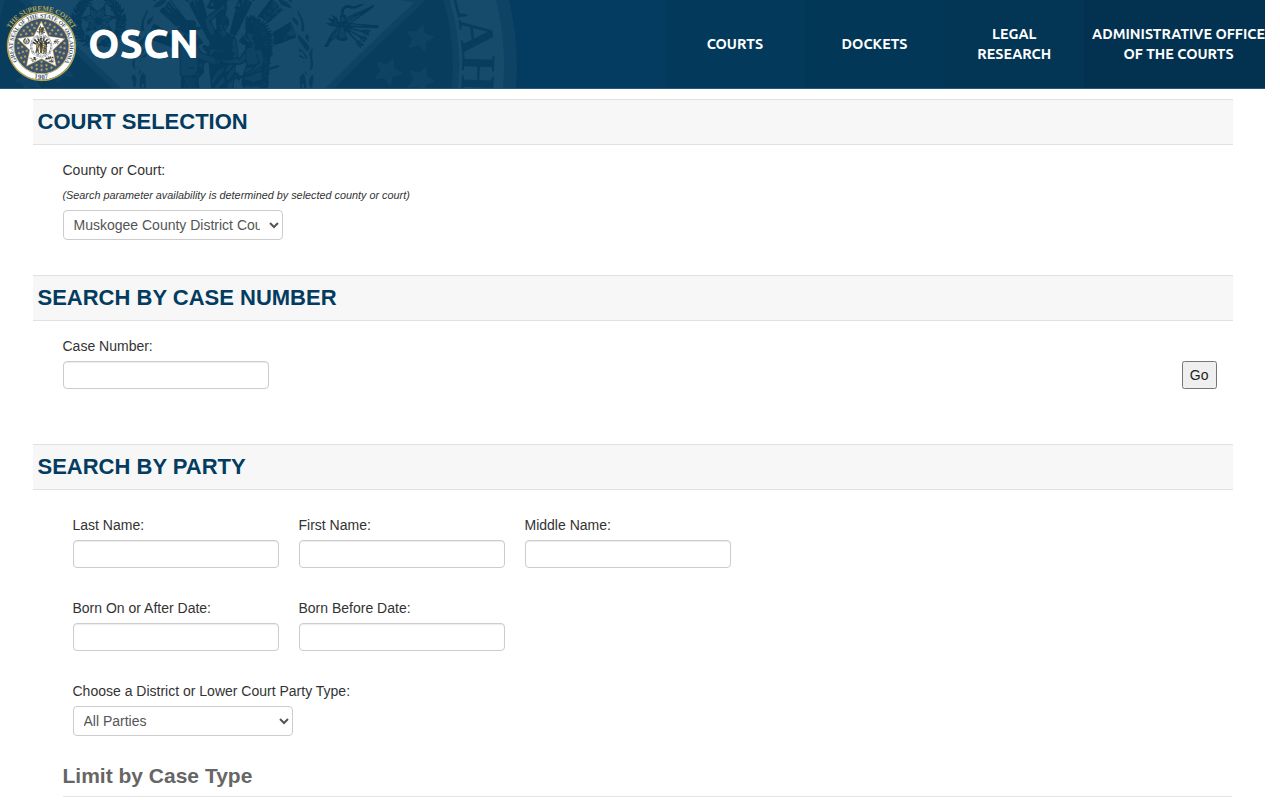
Use the case number when available, then pair the court event with the custodian's actual release time.
Muskogee Release to ICE Custody
The official 2025 Muskogee County ICE Warrant Service Officer agreement creates a possible handoff after local criminal custody ends. It calls for notice before a scheduled local release and allows ICE to assume custody under the agreement's terms. A person can therefore be released by MCSO without being released into the community.
This arrangement does not make Muskogee County Jail an ICE detention center, and it does not make every noncitizen release an immigration event. When a record names ICE as the receiving authority, use the official Online Detainee Locator System. ODLS covers current detainees and a limited recent-release window. Its result ends or confirms ICE custody only; it does not certify the earlier county release reason.
Muskogee Release Alerts and Federal Records
Oklahoma VINE is a free status relay for participating county and state agencies. MCSO sends users there when someone is missing from its roster. Search the correct person, read the precise agency, event, and date, and register through channels offered on the live record. VINE may lag and may not explain whether the event involved bond, time served, or transfer. PPB separately warns that VINE does not provide parole notification.
Federal sentenced custody belongs in the BOP inmate locator. RELEASED or no longer in BOP custody can provide a federal release date but does not prove there is no supervision or other hold. A federal pretrial detainee can leave the county jail under court or USMS authority without becoming a sentenced BOP inmate. Use the Eastern District of Oklahoma docket and actual custodian in that case.
Compare Muskogee Release Sources
Each source answers a smaller question. Combining them prevents a roster absence, board recommendation, or court order from being mistaken for the completed custody event.
| Source | Strong evidence | Limit |
|---|---|---|
| MCSO roster | Person is presently shown locally | Absence does not distinguish release, transfer, or update |
| MCSO release record | Actual local time, reason, and destination when public | May end only county custody |
| Oklahoma VINE | Reported release or transfer event | May lag and is not certified |
| ODOC and PPB | State status, discharge, parole scheduling and action | Do not cover every local booking |
| OSCN or other court | Order, disposition, judgment, sentence | Order time may differ from physical exit |
| BOP, USMS, or ICE | Authority-specific federal status | No one tool covers all federal paths |
Muskogee County Release Facilities
Muskogee County Jail is the local adult detention point. Its release trail begins with MCSO, VINE, and the controlling court, then follows the receiving authority when a transfer appears. Jess Dunn Correctional Center and Dr. Eddie Warrior Correctional Center are ODOC state prisons in Taft. Their releases are state-prison events.
- Muskogee County Jail: county record, VINE, and court docket.
- Jess Dunn Correctional Center: ODOC status or discharge, PPB result, and supervision.
- Dr. Eddie Warrior Correctional Center: ODOC release record, PPB action, and supervision office.
Jess Dunn's official history reaches through several institutional uses before ODOC assumed the site in 1980. That history is distinct, but the practical rule is simple: both Taft prisons use ODOC and PPB, not the MCSO roster.