
Muskogee County VINELink Coverage
Oklahoma VINE is a free, confidential, computer-assisted custody-status service available by website, mobile app, and toll-free telephone. The Oklahoma Attorney General lists phone, email, text or SMS, in-app, and TTY notification channels. The service number is 1-877-654-8463. Any person may use VINE; access is not limited to crime victims.
Muskogee County Sheriff's Office makes the local connection clear. Its in-custody roster tells a user who cannot locate someone that the person may have been released or transferred, then refers the user to Oklahoma VINE. State prison data also participates. That means a record may relate to Muskogee County Jail or an Oklahoma Department of Corrections facility, but the reporting agency and facility must be read on the result. Federal BOP and USMS custody are outside the Oklahoma county and state feed.
The Oklahoma VINELink search screen provides the Find an Offender starting point for a specific Muskogee County custody check.
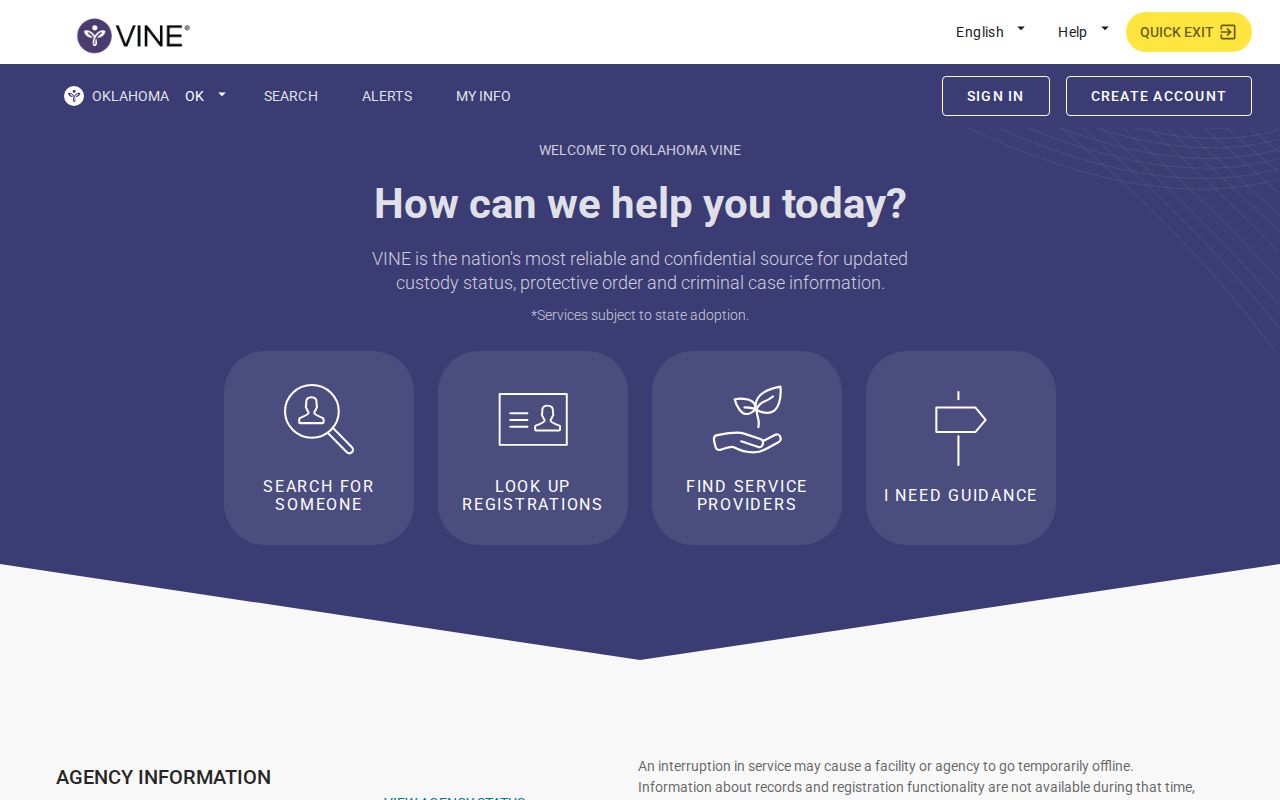
The state selection and reporting-agency details help prevent a match from being attributed to the wrong jail or prison.
Search Muskogee County VINELink Records
Use VINELink for one identified person, not as a substitute for a county-wide recent-release list. Names can collide or change. An offender or inmate identifier is stronger when the live form accepts it. Compare the record's non-sensitive identifying details and custody source before relying on a match. If several results appear, open each plausible record and confirm the reporting agency rather than selecting the first similar name.
- Open VINELink and choose Oklahoma as the state.
- Select Find an Offender and enter the name or identifier accepted by the current form.
- Compare possible matches using the available identity and agency details.
- Open the correct record and note the reporting agency, facility, exact custody status or event, and event date.
- Use the named custodian's record when the release reason, exact time, or destination matters.
A blank result does not prove release. First confirm spelling, variants, the selected state, and any identifier. The participating agency may not have sent an update yet. A short Muskogee County booking and a state prison term also create different records. If the person was never in ODOC, the state offender search may properly return nothing even though a county booking existed.
Note: Record the wording exactly. “Transferred,” “released,” and “out of custody” do not necessarily describe the same destination or legal event.
Muskogee County VINELink Result Fields
The live VINELink record controls which fields appear. A result should be read as a report from the named source, not as a universal corrections file. The most useful details identify who supplied the status and what event the agency reported. A scheduled or expected date should never be recast as an actual release unless the record says the custody event occurred.
| Result detail | How to read it |
|---|---|
| Name or offender identifier | Helps distinguish the intended person from similar matches. |
| Reporting agency | Identifies the jail or corrections source that supplied the event. |
| Facility or location | Shows the institution connected to the current reported status. |
| Custody status or event | May report in custody, released, out of custody, transferred, or another agency term. |
| Event date | Dates the reported change, subject to agency transmission and platform updates. |
| Notification options | Shows which custody events and delivery channels are available for registration. |
A released result can support an immediate check, but it may not explain whether the person posted bond, completed time, received a court order, or entered another form of custody. A transfer result says to continue with the receiving agency. Facility absence alone cannot be translated into discharge. For ODOC records, someone may be outside a prison but still under parole or probation supervision.
- Custody relay
- A service that passes agency status events to users; it is not the certified source record.
- Transfer
- A move from one custodian to another without a community release.
- Discharge
- The formal end of a sentence or supervision status, distinct from leaving one facility.
- Parole
- Conditional community release before the underlying sentence expires.
Set Muskogee County Release Alerts
Registration begins from the correct person's record. Choose the custody-change or notification option offered by the live interface. Available events and channels can vary, so read the current choices instead of assuming every alert type appears. The Attorney General describes in-app, telephone, email, text or SMS, and TTY access. The official materials also describe a four-digit PIN in the phone workflow, when prompted.
- Confirm the person and reporting agency before selecting notifications.
- Choose the release, transfer, or other custody event offered on that record.
- Select an available phone, text, email, in-app, or TTY delivery method.
- Enter the requested contact information and create a four-digit phone PIN if the current workflow asks for one.
- Finish the on-screen confirmation and retain the registration details.
The PIN is used to acknowledge automated phone calls so repeated calls can stop. It is not an offender identifier. Interface steps may change, and the live registration screen should control. Keep contact details current, and do not assume one alert channel substitutes for all others when timely notice is important.
The Oklahoma Attorney General's VINE page documents the available access and notification channels.
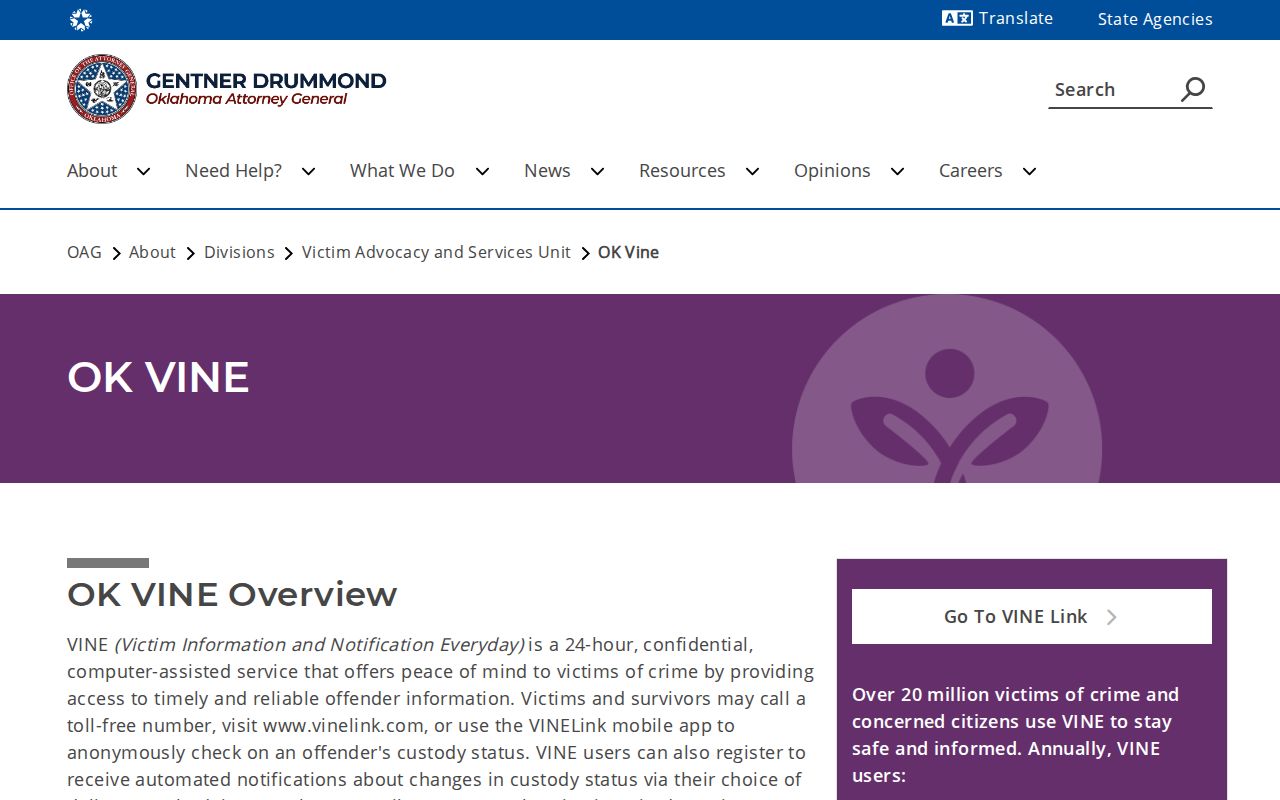
That state resource is the authority for service channels, while the live offender record determines which event options can be selected.
MCSO Supports the VINELink Check
The local sheriff supplies the most distinctive Muskogee County VINE layer. MCSO does not merely link to a general state service. It tells users that release or transfer may explain why someone is absent from the in-custody search and provides the VINE phone number as the immediate next check. That official referral gives VINELink a clear role between the changing county roster and a formal release-record request.
Use the sequence carefully. First, determine whether the person is still shown on the MCSO in-custody roster. Next, read any VINE event and reporting source. Finally, request the MCSO booking and release record when exact time, reason, releasing authority, or destination is needed. The jail can be reached at 918-682-7851 for a current operational question. The Records Division at 220 State Street can handle a targeted historic request.
The MCSO roster warning captures this local referral and explains why VINELink is a cross-check rather than proof from silence.

The sheriff's language preserves both possibilities, release and transfer, until the custody record establishes what happened.
Muskogee County Parole Notification Limits
Oklahoma VINE does not provide parole notification. The Oklahoma Pardon and Parole Board states that limit and operates a separate written victim-notification program for advance parole-hearing and release-to-parole notices. A VINE custody alert therefore should not be presented as notice of every PPB hearing, recommendation, condition, or parole action.
Parole adds several distinct events. A person may be placed on a docket, passed to another review stage, recommended, granted, or later physically released. A result such as parole to a detainer or consecutive sentence is not an immediate community exit. PPB supplies the board action, ODOC supplies implementation and supervision status, and VINE may relay a later custody event. Read all three sources according to their roles.
The Pardon and Parole Board's VINE notice explains the parole-notification gap and also notes a limitation during an ODOC transfer to an Oklahoma mental-health facility.
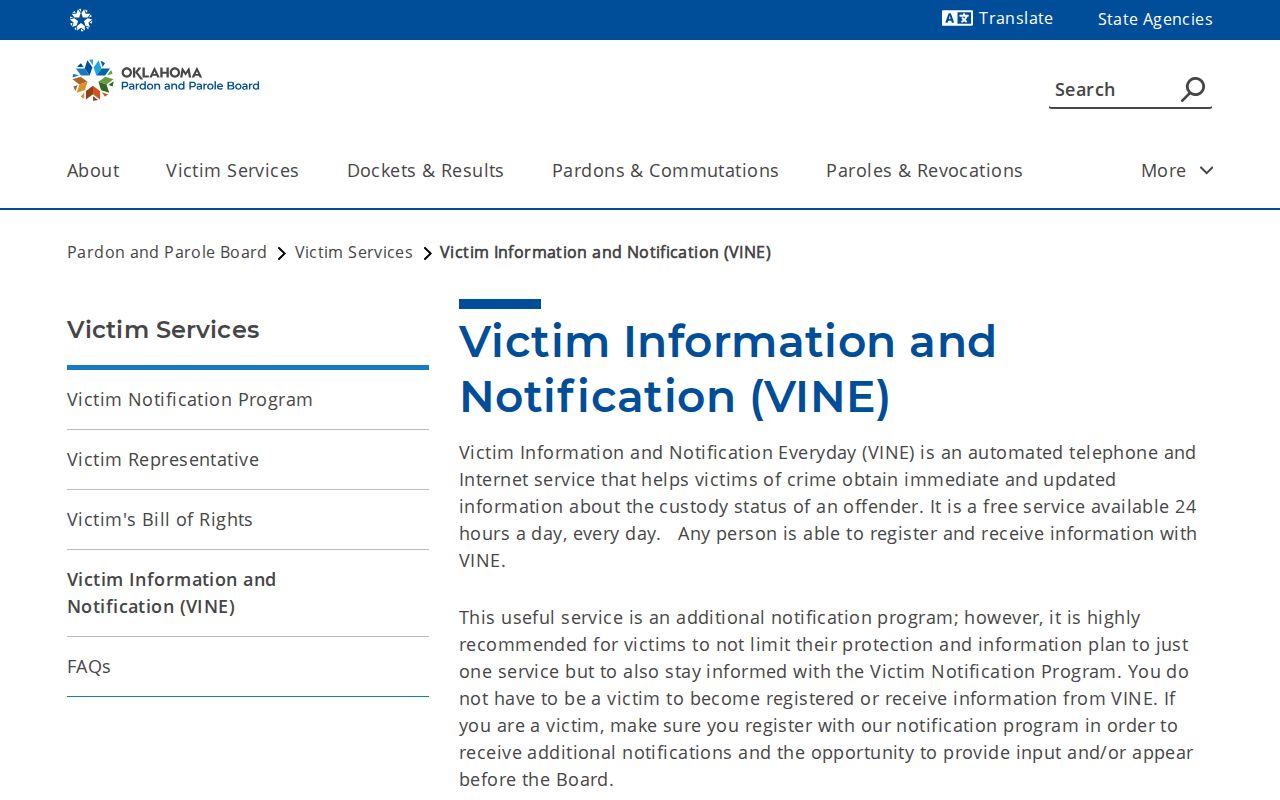
When parole is the concern, use the Board's notification process and records rather than relying only on a custody alert.
Confirm Muskogee County VINELink Events
VINE can lag and may omit the precise basis or destination of a release. A person missing from VINE may also fall outside its scope. For a local county-jail event, use the MCSO Records Division to request the release record and compare the Muskogee district-court docket. Court entries can show bond, dismissal, judgment, jail credit, release orders, or commitment, while the jail record gives the actual physical release or handoff time. If the public docket is incomplete, the Muskogee County Court Clerk can supply the official district-court document.
For a state prisoner, use the ODOC offender search by DOC number when available, then compare exact status, location, offense, dates, and supervision. The ODOC route covers people released from Jess Dunn Correctional Center or Dr. Eddie Warrior Correctional Center. It does not cover every person who spent a short period in Muskogee County Jail. A certified or historic state discharge record comes from ODOC's records custodian.
| Person or event | Source beyond VINELink |
|---|---|
| Muskogee County Jail release | MCSO release record and Muskogee court docket |
| ODOC prison release | ODOC status or discharge record and PPB result when parole applies |
| Federal sentenced person | BOP inmate locator and federal docket |
| Federal pretrial person | USMS or actual custodian and Eastern District docket |
| ICE or tribal handoff | ICE locator or the Muscogee Nation custodian and court |
The Muskogee County released inmate search lays out the full source-by-source path for a named person. Each agency record proves only the custody or legal event within that agency's authority.
When systems disagree, preserve the time and text shown on each source. A later VINE event may reflect normal transmission rather than a different legal result. Ask the named agency for the source record instead of trying to resolve the conflict from the alert alone. For a transfer, continue with the recipient until the person's status is clear.
Note: An absent result, delayed alert, or facility change must not be converted into a claim that the person is free from all custody.